
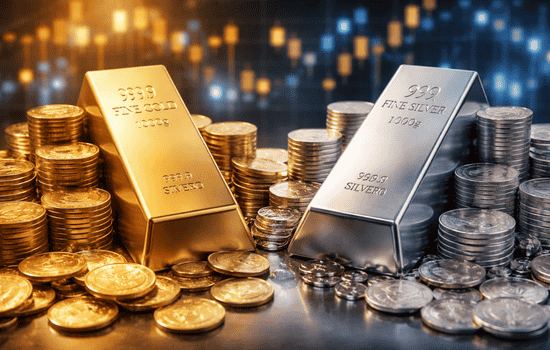

As 2026 unfolds, investors are once again asking a timeless question—should you invest in gold or silver?
While this debate is centuries old, the context in which it exists today is entirely new. Artificial intelligence, renewable energy, rising global debt, digital currencies, and geopolitical uncertainty have transformed how precious metals behave and why people invest in them.
Gold and silver are no longer just “safe assets.”
They now representdifffre represent two distinct financial mindsets.
Gold stands for protection, certainty, and preservation.
Silver represents growth, innovation, and calculated risk.
Understanding which metal fits your strategy in 2026 requires looking beyond tradition and focusing on economics, technology, and human behavior.
Understanding the Fundamental Difference Between Gold and Silver
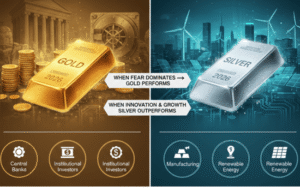
The most important distinction between gold and silver lies in how the global economy uses them.
Gold functions primarily as a monetary and reserve asset.
Silver plays a dual role—it is both a precious metal and a critical industrial material.
A large portion of gold demand comes from:
- Central banks
- Institutional investors
- Jewelry markets
- Long-term wealth holders
Silver demand, on the other hand, is heavily influenced by:
- Manufacturing
- Renewable energy
- Electronics
- Electric vehicles
- Medical technology
This difference alone explains why gold and silver behave so differently during economic cycles.
When fear dominates markets, gold usually performs better.
When innovation and growth accelerate, silver tends to outperform.
In 2026, the world is experiencing both forces at the same time.
The Global Economic Environment in 2026
To understand precious metals in 2026, we must first look at the broader economic picture.
Inflation and Currency Pressure
Although inflation rates fluctuate, the long-term reality remains clear—global debt levels are historically high. Governments continue to borrow, and currencies continue to lose purchasing power over time.
When trust in fiat money weakens, investors turn to tangible assets.
Gold has traditionally been the first choice during currency devaluation.
Silver also benefits, but its response is often tied to economic growth rather than fear alone.
Geopolitical Uncertainty
Trade conflicts, regional wars, energy insecurity, and political instability continue to shape global markets.
Gold thrives in uncertainty.
It has no counterparty risk and no dependency on technology or infrastructure.
Silver often follows gold during crises, but with greater volatility.
Technology and Industrial Expansion
What makes 2026 unique is the scale of technological transformation.
Industries driving silver demand include:
- Solar energy
- Electric vehicles
- AI hardware and data centers
- Semiconductor manufacturing
- Medical devices
Gold does not benefit directly from technological adoption, while silver does.
This structural difference plays a major role in long-term performance.
Why Gold Still Matters in 2026
Gold’s Role in Modern Investment Portfolios
Gold is no longer just a hedge against inflation—it has become strategic insurance.
Central banks across Asia, Eastern Europe, and the Middle East are steadily increasing their gold reserves. This signals a long-term shift away from complete reliance on fiat currencies.
For individual investors, gold serves as:
- A store of value
- A hedge against systemic risk
- A stabilizer during market crashes
In an increasingly digital financial world, gold represents something physical, finite, and independent.
Strengths of Gold as an Asset
Gold is known for:
- Lower volatility compared to equities
- Strong performance during crises
- Long-term value preservation
- High liquidity across global markets
However, gold has clear limitations.
It does not generate income.
It does not benefit from productivity growth.
It does not scale with technological advancement.
Gold protects wealth—it does not multiply it.
Why Silver Is Gaining Attention in 2026
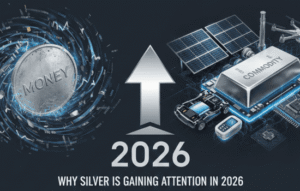
Silver’s Unique Dual Nature
Silver occupies a rare position in the financial world.
It behaves like money during monetary crises and like a commodity during economic expansion. This dual identity makes silver more volatile—but also more powerful.
Industrial Demand Is Reshaping Silver’s Future
Silver demand is rising due to long-term structural trends:
Renewable Energy
Solar panels rely on silver for conductivity. As nations invest in clean energy, silver demand grows steadily.
Electric Vehicles
EVs use more silver than traditional vehicles due to advanced electronics and battery systems.
AI and Semiconductor Manufacturing
High-performance chips require efficient conductive materials, where silver plays a vital role.
Medical and Defense Applications
Silver’s antimicrobial properties and reliability make it valuable in advanced healthcare and defense systems.
Unlike gold, silver is often consumed during industrial use and not fully recycled. This creates long-term supply pressure.
Supply Constraints
Most silver production comes as a byproduct of mining other metals. This limits the ability to rapidly increase supply even when demand rises.
This imbalance between supply and demand could significantly influence prices in the coming years.
Risk and Return: Gold vs Silver
Choosing between gold and silver depends largely on risk tolerance.
Gold: Stability First
Gold is ideal for:
- Conservative investors
- Wealth preservation
- Retirement portfolios
- Crisis protection
Gold rarely experiences dramatic price crashes, but it also rarely delivers explosive growth.
Silver: Growth With Volatility
Silver appeals to:
- Growth-focused investors
- Traders and speculative investors
- Technology-driven macro believers
Silver often amplifies gold’s movements. When gold rises modestly, silver can rise sharply. When gold falls, silver often falls harder.
This volatility can be rewarding—or painful.
Interest Rates and Monetary Policy in 2026
Interest rates remain one of the most important drivers of precious metals.
- Rising rates tend to pressure gold
- Falling or flexible rates support gold
- Strong industrial demand can allow silver to rise even when rates are high
In 2026, central banks are expected to maintain cautious and flexible policies due to fragile economic conditions.
This environment generally favors precious metals—especially silver.
Gold and Silver vs Digital Assets
The rise of cryptocurrencies has reshaped the investment landscape.
Some investors view Bitcoin as “digital gold.”
Others see gold as protection against digital risk itself.
Silver has no digital replacement.
Cryptocurrencies do not replace silver’s industrial function. As a result:
- Gold competes with crypto as a store of value
- Silver benefits regardless of crypto adoption
This gives silver a strategic advantage in a technology-driven future.
Smart Portfolio Allocation for 2026
Rather than choosing one metal, many investors are choosing allocation strategies.
Conservative Approach
- 70–80% gold
- 20–30% silver
Balanced Approach
- 50–60% gold
- 40–50% silver
Aggressive Approach
- 30–40% gold
- 60–70% silver
Gold provides protection.
Silver provides growth.
The Psychological Side of Investing
Markets are driven by emotion as much as data.
Gold represents safety, tradition, and caution.
Silver represents optimism, progress, and innovation.
2026 is a year defined by both uncertainty and opportunity. This is why both metals remain relevant.
Long-Term Outlook Beyond 2026
Gold’s Future
Gold will remain a global reserve asset as long as governments rely on debt and monetary expansion. Its growth may be slow, but its role as financial insurance is unlikely to disappear.
Silver’s Future
Silver’s future is tied directly to technological adoption and sustainability initiatives. If clean energy, AI, and electrification continue to expand, silver demand could grow significantly.
Higher potential comes with higher uncertainty—but also higher rewards.
Final Verdict: Gold or Silver in 2026?
There is no single winner.
Gold is better for:
- Stability
- Crisis protection
- Long-term security
Silver is better for:
- Growth
- Innovation-driven demand
- Higher return potential
The smartest investors in 2026 are not choosing sides—they are building balanced strategies.
Gold forms the foundation.
Silver provides acceleration.
In a world shaped by uncertainty and innovation, balance is the strongest position.
Simple Takeaway
- Fear economic instability? Choose gold.
- Believe in technological growth? Choose silver.
- Want a resilient future-proof portfolio? Choose both.
Disclaimer: This article is for educational purposes only and does not constitute financial advice.