
Impact of AI on Civil Engineering Project Planning
Civil engineering project planning is changing fast — and artificial intelligence is leading that change. What once required weeks of manual coordination, complex spreadsheets, and constant revisions can now be handled with intelligent systems that analyze data in seconds.
Think about shorter timelines, lower costs, fewer errors, and smarter decisions. That’s what AI is bringing to construction and infrastructure planning.
Experts predict that by 2030, nearly 80% of routine project management tasks could be automated using AI-powered systems. This is not a distant future — it is already happening.
In this article, we’ll explore how AI is reshaping civil engineering project planning, making projects more efficient, more predictable, and more intelligent. Whether you are an experienced engineer or just entering the field, understanding AI is becoming essential to stay competitive.
What Is AI in Civil Engineering Project Planning?
Artificial Intelligence (AI) refers to advanced software systems that use machine learning and data analysis to make predictions, automate tasks, and improve decision-making.
In civil engineering project planning, AI can:
- Analyze historical project data
- Predict possible risks
- Optimize construction schedules
- Improve resource allocation
- Generate accurate cost forecasts
Instead of relying only on human estimates and manual tracking, engineers can now use AI-driven insights to plan projects with greater confidence and precision.
AI reduces human error, enhances safety standards, and improves cost efficiency — all while saving time.
Key Impacts of AI on Civil Engineering Project Planning
1. Smarter Scheduling and Improved Accuracy
Project scheduling has traditionally been a complex and time-consuming process. Planners had to manually adjust timelines based on labor availability, materials, and changing site conditions.
AI now automates this process.
Modern AI scheduling tools analyze real-time data such as:
- Weather forecasts
- Supply chain updates
- Workforce availability
- Equipment usage
Studies show AI-powered scheduling can:
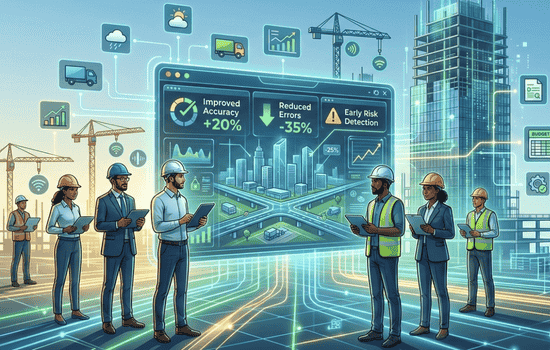
- Improve schedule reliability by up to 20%
- Reduce planning errors by around 35%
This means fewer delays, better coordination, and more on-time project delivery.
AI-based task management systems also allow dynamic task assignment. If something changes on-site, the system adjusts instantly — reducing bottlenecks and confusion.
2. More Accurate Cost Estimation
Budget overruns are one of the biggest challenges in construction projects.
Machine learning models can now evaluate:
- Past project budgets
- Labor cost fluctuations
- Material price trends
- Project scale and complexity
Using this data, AI tools generate far more precise cost predictions.
Research suggests that AI can:
- Improve cost estimation accuracy by up to 30%
- Reduce budget overruns by nearly 40%
This helps companies stay financially stable and avoid unexpected financial risks.
3. Early and Proactive Risk Detection

In traditional planning methods, risks were often discovered only after becoming serious problems.
AI changes that.
Predictive analytics models can simulate thousands of possible scenarios before construction even begins. These systems analyze patterns from past projects to identify potential risk factors early.
AI-driven risk management tools have shown the ability to identify nearly 87% of possible risk elements during the planning phase — compared to roughly 43% using conventional approaches.
By identifying risks early, engineers can:
- Adjust schedules
- Allocate backup resources
- Prevent costly delays
- Improve safety planning
4. Generative Design and Optimization
Design optimization is another area where AI is making a huge impact.
With generative AI tools, engineers can input design goals such as:
- Structural strength
- Budget limits
- Energy efficiency targets
- Sustainability requirements
The AI system then generates thousands of possible design alternatives and evaluates each one.
This allows engineers to select the most efficient and cost-effective design in a fraction of the time required for manual design iterations.
Generative design improves:
- Structural performance
- Material efficiency
- Environmental sustainability
- Decision-making speed
5. Better Resource Allocation
Managing labor, equipment, and materials efficiently is critical to project success.
AI systems analyze historical and real-time data to predict:
- When equipment will be needed
- Where labor shortages may occur
- How materials should be distributed
Some AI resource management systems have reduced equipment idle time by more than 40%.
Better resource planning leads to:
- Reduced waste
- Lower operational costs
- Improved productivity
Challenges to AI Adoption in Civil Engineering

Despite its advantages, adopting AI is not without challenges.
High Initial Investment
Implementing AI tools and integrating them with existing systems can require significant financial investment.
Data Quality Issues
AI systems rely heavily on accurate historical data. In construction, data is often scattered or poorly documented.
Skill Gap
There is a shortage of professionals who understand both civil engineering and AI technologies.
Resistance to Change
The construction industry has traditionally relied on manual processes. Some professionals remain skeptical about automated decision-making.
Overcoming these challenges will require training, better data management, and gradual integration strategies.
Frequently Asked Questions (FAQs)
1. How does AI improve construction project planning?
AI improves planning by analyzing large datasets to predict delays, optimize schedules, manage risks, and allocate resources more effectively.
2. What are the major benefits of AI in project management?
Key benefits include improved scheduling accuracy, better cost estimation, proactive risk management, optimized resource allocation, and faster decision-making.
3. What AI tools are commonly used in civil engineering?
Popular tools include:
- Building Information Modeling (BIM) platforms
- AI scheduling solutions like ALICE Technologies
- Smart construction management systems such as Procore
4. Can AI predict construction delays?
Yes. AI uses predictive analytics to examine historical trends, environmental conditions, and operational data to identify potential delays before they happen.
The Future of AI in Civil Engineering
Artificial intelligence is no longer optional in civil engineering project planning — it is becoming essential.
From smarter scheduling and cost forecasting to risk prevention and generative design, AI is reshaping how infrastructure projects are planned and executed.
As the technology advances, its influence will only grow stronger. Engineers who adopt AI-driven tools will gain a clear competitive advantage in efficiency, accuracy, and innovation.
The future of construction is data-driven, intelligent, and automated — and AI is leading the way.